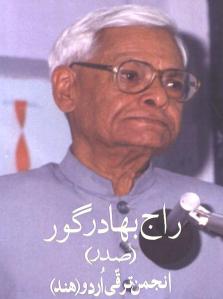
 Dr Raj Bahadur Gour, who was perhaps the last pillar of the composite culture and Deccan’s tehzeeb of yore passed away in Hyderabad.
Gour, 93, was a close associate of legendary poet and revolutionary Makhdoom Mohinuddin. Dr Gour was not just a communist leader, a former MP and a champion for the rights of Urdu, but also a symbol of secularism & humanity.
His death was mourned across the world, particularly, in Urdu circles. Dr Gour who was born in 1918, had passed his MBBS examination from Osmania University in Urdu medium.
He along with Makdhoom, Alam Khundmiri and Javed Rizwi, formed the Comrade Association, which was banned. As a participant in the Telangana Armed Revolution in the era, he was arrested and jailed.
An intellectual, a writer and a great human being, Dr Gour remained associated with Anjuman Taraqqi-e-Urdu for 40 years, and was elects its president also.
In a programme organised at Urdu Ghar in Delhi to pay last respects to Dr Gour, Professor Akhtarul Wasey said that late Raj Bahadur Gour’s name will always be taken with great respect in Urdu circles, along with names like Tej Bahadur Sapru, Anand Narayan Mulla and Hriday Nath Kunzru.
Renowned poet Anand Mohan Zutshi Gulzar Dehlvi said that Dr Raj Bahadur Gaur was a fearless crusader for Urdu and a man who epitomised Urdu culture.
Khaliq Anjum, Ali Javed, Syed Shariful Hasan Naqvi, Aslam Parvez and Shauq Amrohvi were amongst others who paid rich tributes to Dr Gour.
Just a few days before his death he had donated Rs 3 lakh to Urdu Talimi Trust from his personal assets. Once when Urdu was under attack and termed a ‘Muslim language’, he made the famous statement:
“If Urdu is the language of Muslims alone then how come all the national slogans from Inquilab Zindabad to Gharibi Hatao are in Urdu alone”.
He would often say Urdu was his mother tongue while English was his stepmother tongue. He often recalled how in the pre-partition era and the days after police action, there was a feeling against Nizam but never against Muslims or Urdu in Hyderabad Deccan.
Now we have hardly any towering personality who could speak courageously for Urdu and even fewer among non-Muslims who can claim the zaban as their mother tongue.
Urdu India salutes this Mard-e-Mujahid of Urdu.
PS: Sad that Urdu papers in Deccan didn’t carry the news of his death as prominently as was expected of them. In Mumbai, special page-1 editorials were published and in Urdu papers in North also, the news that he passed away was splashed on front page and obituaries published for days.
Indscribe
Filed under: Urdu World: News & Views | 2 Comments »


 I have heard about Mehfil-e-Muqasida quite often but didn’t have much information about them. I have attended ‘Tarahi’ mushairas but could never participate in such mehfils.


 The World of Urdu Poetry, Literature & News